Internal Experience Design & Operational UX
Customer Engagement Operating Model
Designed the end-to-end internal service, operating model, cross-functional processes, technology ecosystem, and knowledge management framework that enabled an iGaming brand to launch outbound calling as a new customer engagement channel.
Platform :
Web
Industry :
iGaming
Role :
Lead Service Designer
Scope :
Service Design & Operational UX
Problem :
An iGaming company with a mature email and SMS retention channel wanted to grow through outbound calling, a capability that didn't exist anywhere in the organization. There was no infrastructure, no sales workflow, no voice-specific QA framework, and no process for managing outbound contact compliantly at scale. The risk wasn't purely operational: launching without a designed system meant regulatory exposure, a fragmented player experience, and no mechanism to learn or improve. The brief wasn't to configure a tool. It was to design an entire service system, the technology layer, the human workflows, the quality feedback loops, and the governance structures, before a single call was made.

Challenge :
Designing an internal service from scratch is fundamentally different from redesigning one. Every decision, from how campaign lists would reach agents to how QA feedback would flow back to them, had to be made before any real evidence existed. The hardest constraint was that the organization, the tools, the team, and the processes were all being created simultaneously.
Beyond the structural complexity, this was a regulated environment where every agent-player interaction carried compliance responsibility. Responsible gambling protocols, opt-out rules, and contact restrictions all needed to be embedded into the operational design from day one. At the same time, agents were expected to navigate multiple tools live on calls while maintaining rapport, handling objections, and staying within regulatory boundaries. Reducing cognitive load without reducing compliance rigor was the central design tension throughout the project.


Designing the Operation :
The solution wasn't one deliverable, it was a full operational infrastructure, designed across four layers simultaneously: the tools agents would use, the workflows they'd follow, the quality and compliance framework that would hold every call to account, and the governance layer that would make improvement compounding rather than incidental.
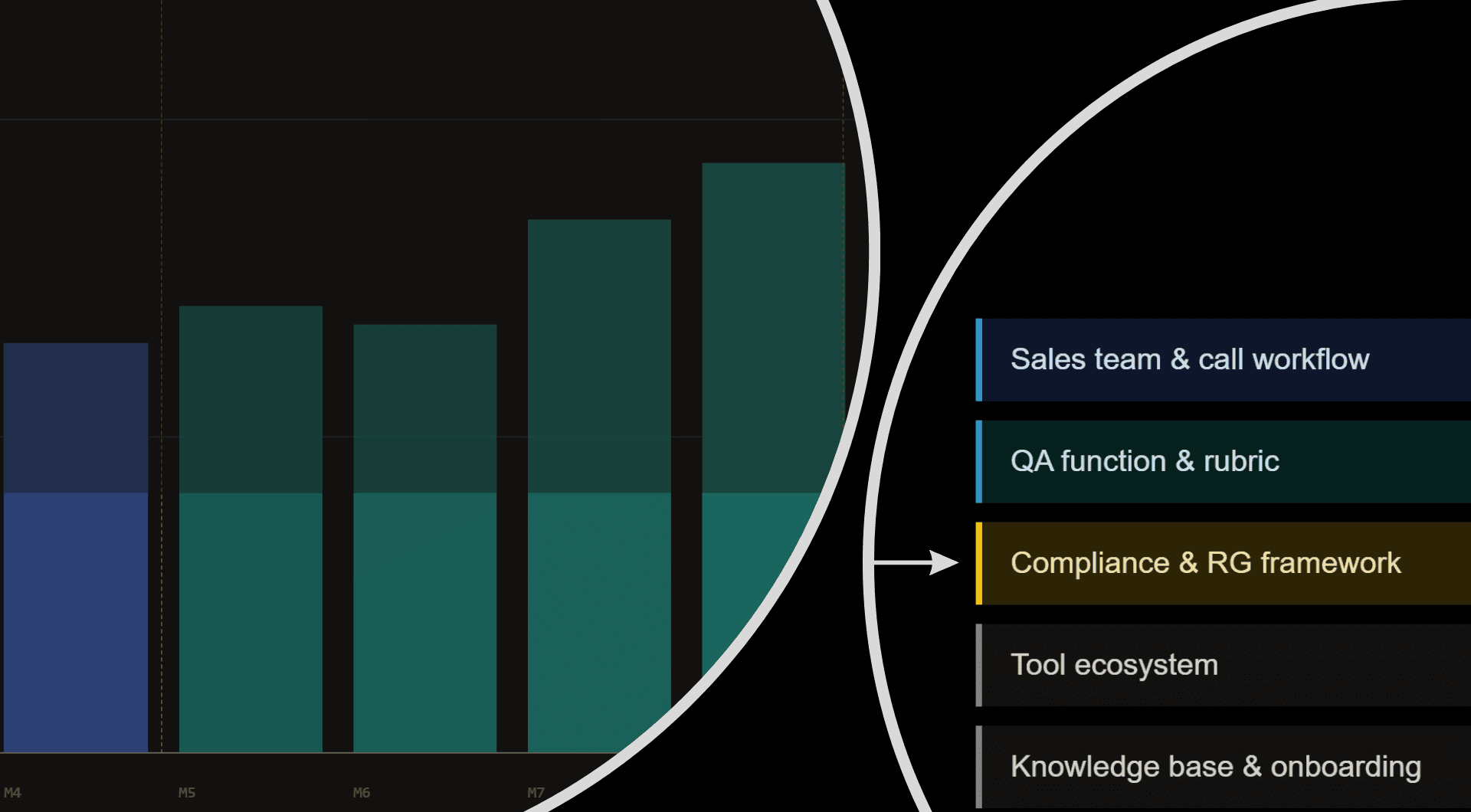
A seven-phase service blueprint aligned commercial, compliance, operations, and QA teams around a single model of how the service would run, before anyone made a single call. The agent journey map did something more specific: it located the moments where compliance requirements would create the most pressure on live performance, and shaped the workflow and tooling decisions around absorbing that load, reducing friction without removing guardrails. Tool selection, QA scorecard design, knowledge base architecture, and performance reporting were designed as one system. Not separate briefs. Not sequential handoffs.
The design didn't stop at launch. UX principles that shaped the agent workflow were translated directly into the QA scorecard, so the criteria used to assess every call were the same ones used to design it. Cohort logic and call structure were refined quarterly as live data came in. The role wasn't to deliver and hand off; it was to own the operational model through its maturation.
Summary :
Reactivation among contacted players more than doubled year-on-year, from 18.6% to 39.7%. Sale rate reached 85.6% overall, up from 80.8% at launch, hitting 89.3% by year end, as the coaching framework took hold. In year two, the team generated comparable reactivations from 60% fewer calls.
By the end of the tracked period: nearly 264,000 players reactivated, operational design that generated eight-figure first-day deposit value at scale, across 20+ markets. Built from nothing, eighteen months prior.

More Projects



Internal Experience Design & Operational UX
Customer Engagement Operating Model
Designed the end-to-end internal service, operating model, cross-functional processes, technology ecosystem, and knowledge management framework that enabled an iGaming brand to launch outbound calling as a new customer engagement channel.
Platform :
Web
Industry :
iGaming
Role :
Lead Service Designer
Scope :
Service Design & Operational UX
Problem :
An iGaming company with a mature email and SMS retention channel wanted to grow through outbound calling, a capability that didn't exist anywhere in the organization. There was no infrastructure, no sales workflow, no voice-specific QA framework, and no process for managing outbound contact compliantly at scale. The risk wasn't purely operational: launching without a designed system meant regulatory exposure, a fragmented player experience, and no mechanism to learn or improve. The brief wasn't to configure a tool. It was to design an entire service system, the technology layer, the human workflows, the quality feedback loops, and the governance structures, before a single call was made.
Challenge :
Designing an internal service from scratch is fundamentally different from redesigning one. Every decision, from how campaign lists would reach agents to how QA feedback would flow back to them, had to be made before any real evidence existed. The hardest constraint was that the organization, the tools, the team, and the processes were all being created simultaneously.
Beyond the structural complexity, this was a regulated environment where every agent-player interaction carried compliance responsibility. Responsible gambling protocols, opt-out rules, and contact restrictions all needed to be embedded into the operational design from day one. At the same time, agents were expected to navigate multiple tools live on calls while maintaining rapport, handling objections, and staying within regulatory boundaries. Reducing cognitive load without reducing compliance rigor was the central design tension throughout the project.
Designing the Operation :
The solution wasn't one deliverable, it was a full operational infrastructure, designed across four layers simultaneously: the tools agents would use, the workflows they'd follow, the quality and compliance framework that would hold every call to account, and the governance layer that would make improvement compounding rather than incidental.
A seven-phase service blueprint aligned commercial, compliance, operations, and QA teams around a single model of how the service would run, before anyone made a single call. The agent journey map did something more specific: it located the moments where compliance requirements would create the most pressure on live performance, and shaped the workflow and tooling decisions around absorbing that load, reducing friction without removing guardrails. Tool selection, QA scorecard design, knowledge base architecture, and performance reporting were designed as one system. Not separate briefs. Not sequential handoffs.
The design didn't stop at launch. UX principles that shaped the agent workflow were translated directly into the QA scorecard, so the criteria used to assess every call were the same ones used to design it. Cohort logic and call structure were refined quarterly as live data came in. The role wasn't to deliver and hand off; it was to own the operational model through its maturation.
Summary :
Reactivation among contacted players more than doubled year-on-year, from 18.6% to 39.7%. Sale rate reached 85.6% overall, up from 80.8% at launch, hitting 89.3% by year end, as the coaching framework took hold. In year two, the team generated comparable reactivations from 60% fewer calls.
By the end of the tracked period: nearly 264,000 players reactivated, operational design that generated eight-figure first-day deposit value at scale, across 20+ markets. Built from nothing, eighteen months prior.
More Projects
Internal Experience Design & Operational UX
Customer Engagement Operating Model
Designed the end-to-end internal service, operating model, cross-functional processes, technology ecosystem, and knowledge management framework that enabled an iGaming brand to launch outbound calling as a new customer engagement channel.
Platform :
Web
Industry :
iGaming
Role :
Lead Service Designer
Scope :
Service Design & Operational UX
Problem :
An iGaming company with a mature email and SMS retention channel wanted to grow through outbound calling, a capability that didn't exist anywhere in the organization. There was no infrastructure, no sales workflow, no voice-specific QA framework, and no process for managing outbound contact compliantly at scale. The risk wasn't purely operational: launching without a designed system meant regulatory exposure, a fragmented player experience, and no mechanism to learn or improve. The brief wasn't to configure a tool. It was to design an entire service system, the technology layer, the human workflows, the quality feedback loops, and the governance structures, before a single call was made.
Challenge :
Designing an internal service from scratch is fundamentally different from redesigning one. Every decision, from how campaign lists would reach agents to how QA feedback would flow back to them, had to be made before any real evidence existed. The hardest constraint was that the organization, the tools, the team, and the processes were all being created simultaneously.
Beyond the structural complexity, this was a regulated environment where every agent-player interaction carried compliance responsibility. Responsible gambling protocols, opt-out rules, and contact restrictions all needed to be embedded into the operational design from day one. At the same time, agents were expected to navigate multiple tools live on calls while maintaining rapport, handling objections, and staying within regulatory boundaries. Reducing cognitive load without reducing compliance rigor was the central design tension throughout the project.
Designing the Operation :
The solution wasn't one deliverable, it was a full operational infrastructure, designed across four layers simultaneously: the tools agents would use, the workflows they'd follow, the quality and compliance framework that would hold every call to account, and the governance layer that would make improvement compounding rather than incidental.
A seven-phase service blueprint aligned commercial, compliance, operations, and QA teams around a single model of how the service would run, before anyone made a single call. The agent journey map did something more specific: it located the moments where compliance requirements would create the most pressure on live performance, and shaped the workflow and tooling decisions around absorbing that load, reducing friction without removing guardrails. Tool selection, QA scorecard design, knowledge base architecture, and performance reporting were designed as one system. Not separate briefs. Not sequential handoffs.
The design didn't stop at launch. UX principles that shaped the agent workflow were translated directly into the QA scorecard, so the criteria used to assess every call were the same ones used to design it. Cohort logic and call structure were refined quarterly as live data came in. The role wasn't to deliver and hand off; it was to own the operational model through its maturation.
Summary :
Reactivation among contacted players more than doubled year-on-year, from 18.6% to 39.7%. Sale rate reached 85.6% overall, up from 80.8% at launch, hitting 89.3% by year end, as the coaching framework took hold. In year two, the team generated comparable reactivations from 60% fewer calls.
By the end of the tracked period: nearly 264,000 players reactivated, operational design that generated eight-figure first-day deposit value at scale, across 20+ markets. Built from nothing, eighteen months prior.